PART 1: À l’Est
The Bercy train station feels like jumping back in time 25 years. It comes from an era that screams, "Hey, we just discovered this technology called LEDs!" And so do its trains.
In nearly all the train stations in Paris, it’s purely luck that decides whether your train was built yesterday or in the 1990s. As this was my first time taking a train from Bercy, we might have just caught the one old train still hanging onto its tracks. In any case, that’s exactly what we were given. At first glance, it looked clean, sized somewhere between a subway car and the average cross-country railer. It had a handful of single-level cars, no overhead racks, and no bar car in sight. Upon closer inspection, and after walking up and down the aisle in search of a good seat (this particular train is open seating), we noticed most of the tables and floors were covered in a thin, sticky layer of what could best be described as old juice. The seats themselves were a bit worn through. No matter.
Once the herd of scouts and scout leaders, backpacks bobbing about, found their way to their seats, and all the Parisians looking to get their mountain bikes out of the city managed to sleepily drag their rides onboard, we embarked. We left on time, but with the unrelenting crackle of metal slowly clicking and crunching underneath the chassis. This was likely the result of an old train running on tracks made for a newer generation.
Showing up to Bercy station on a Saturday morning in spring can only really mean one thing: you’re headed east. Well, more precisely, southeast. You’re heading to the region known in French as Bourgogne, and in English as Burgundy.
Once our ride managed to crunch along to normal train speed, we slipped out of the yard and into the countryside. A mere 20 minutes later, the entire landscape could be described in a single word: Green.
Every shade of green rolled across the hills and patches of forest, surrounding nestled villages and racing vibrantly along rivers. Occasionally, an odd, medium-small city would pop out of the landscape. This time, it brought a bit of a depressing industrial vibe, but only briefly, before we plunged back into the waves of green. Leaves of every shape and size raced to unfold in the sunlight of what was still only the first weeks of spring, and maybe only the second weekend of warm weather.
As we descended southeast towards Fontainebleau and Montereau, we were simultaneously working our way up the Seine to its wilder, fresher stretches, before it gets tamed and squished past the islands of Paris. Our destination was the city of Joigny.
As we made our way farther from home, sunburst fields of colza began to peek out in giant rectangles from behind stone-house villages, nestled between roads and long lines of neatly groomed poplar trees. Endless flowers careening down hills into giant yellow pools below.
The rest came in vignettes: someone’s potager, the clock towers of town churches, fields divided by borders of unkempt, short, scruffy trees, a woman fighting with a spray hose at a roadside car wash, tractor lines through emerald fields like a thoughtfully raked Zen garden, my shoes sticking to mystery goo on the train floor, and tracks running under us as if metal could gurgle.
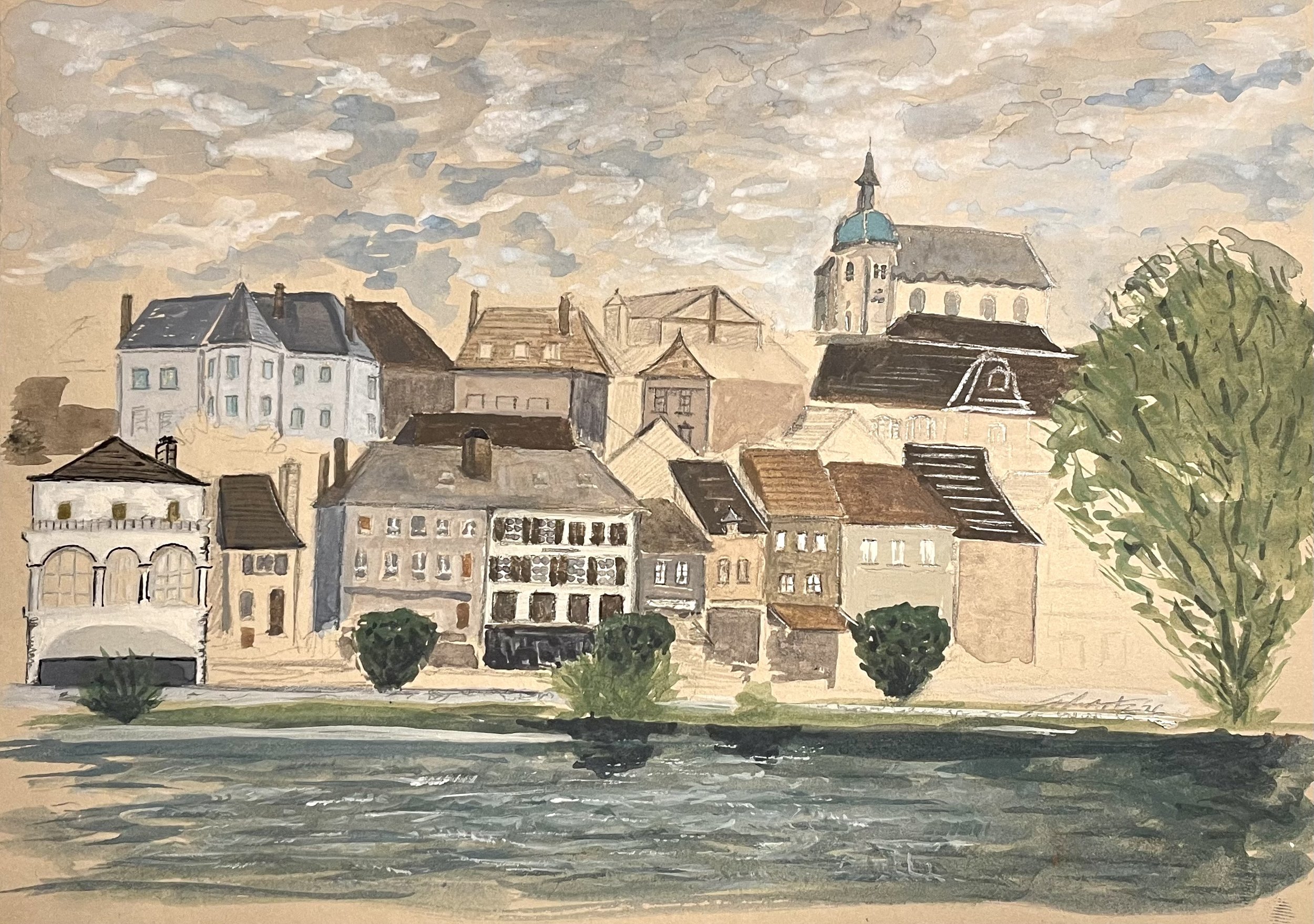
Upon arriving in Joigny, we found a clean train station of appropriate size. We set off on foot down an ordinary commercial boulevard featuring a bar, a tobacco shop, and a salon. Ten minutes or so later, we arrived at the Yonne River, with its stone, flower-covered bridge, and crossed into the old city center. Perched on a hill, it had exactly the cobbled streets and historic facades we were searching for.
I will say this: for a small, quiet city of roughly 10,000 people, with many vacant retail spaces and ancient buildings to maintain, there is a lot of rehabilitation work being done. It was obvious to us that the citizens and city hall care deeply about the upkeep and future of their patrimoine (their heritage).
We began the day at the covered market, where apparently everyone goes to get their weekly fill of local cheeses, wines, and honey. We watched local farmers chatting with their regulars, and saw oysters sold by the dozen, ready to be eaten just outside with a bottle of wine overlooking the Yonne. The rest of the day was spent wandering through the incredibly vertical streets of the old town, eating ice cream from a regional maker, hiking up through some fields overlooking the village, picking through a quaint bookshop with a rowdy bull terrier as its mascot, and day-drinking.
We thoroughly enjoyed our day exploring a new city that had only recently popped onto our radar.
And just two days later… we came across a listing for a country house in a village less than 10 minutes away…
Artwork by Benjamin Schwartz