PART 2: À l’Est
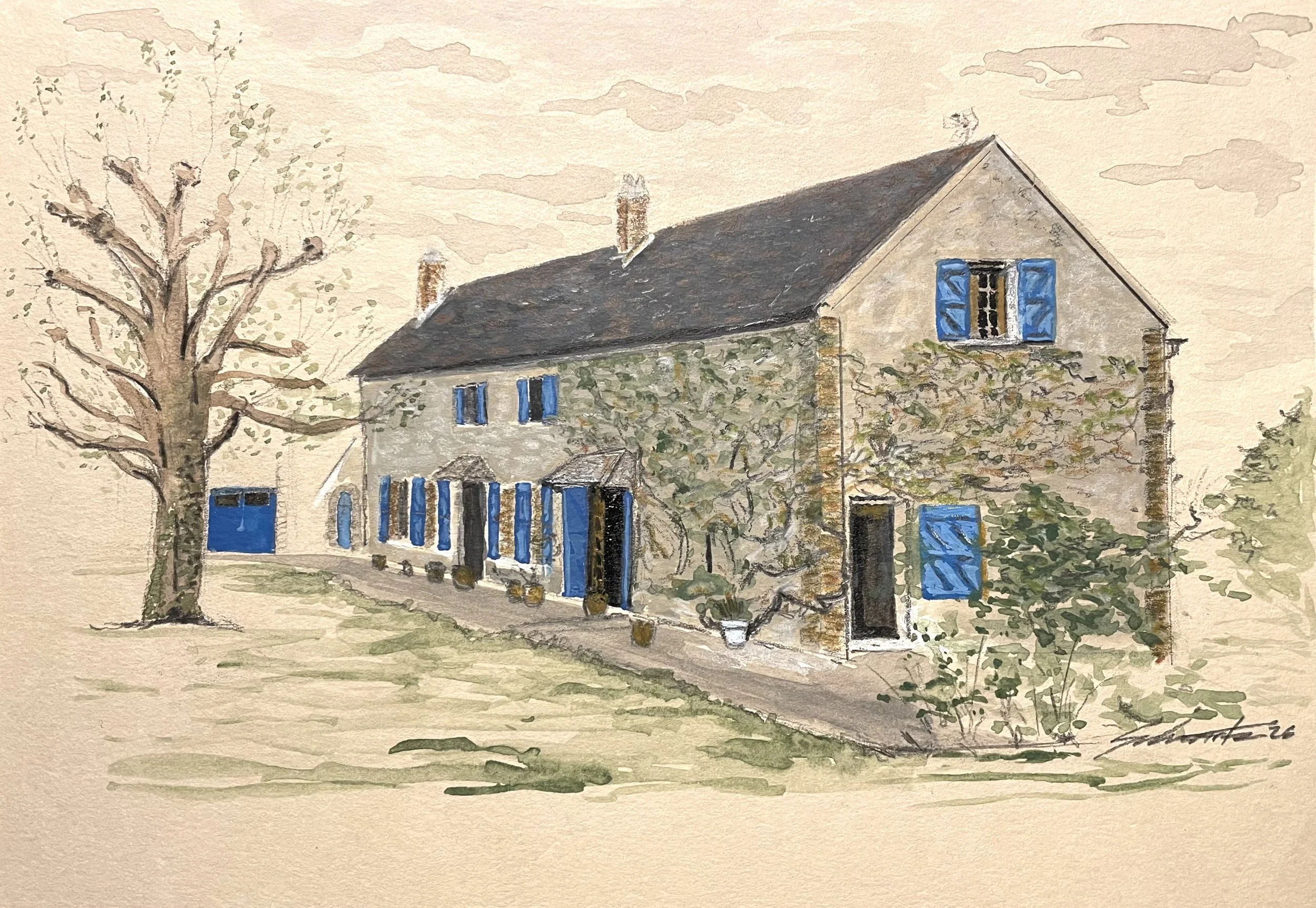
After a wonderful Saturday in Burgundy spent exploring the small city of Joigny (a place completely unknown to us until then), it felt like an interesting turn of fate when, just two days later, a real estate listing popped up on my phone for a countryside house in a village less than 10 minutes away. Strangely, it seemed to check all the boxes, but I was hesitant to make any assumptions.
My wife, Mélanie, and I had been actively searching for a home in the countryside for over a year. We wanted a place where we could escape the crowds and din of Paris, a life project where we could eventually transition more of our time, host family and friends, and one day retire. We had become quite good at scanning our apps and websites every morning, sending listings to a shared digital space where we could add comments or different levels of smiley faces, ranging from "not impressed" to "maybe this is something." However, after a year of searching within the confines of a very tight budget, resulting in many visits that ended in sad defeat, it was difficult to believe our future home actually existed. We took a pause at the end of 2025 to step back from the weight of it all, but we jumped back in early 2026 with renewed energy and fresh ideas about where to look.
Our requirements were clear: the house had to be under two hours from Paris by car and train, situated in a countryside setting that wasn’t completely devoid of resources, and free of surprise drawbacks (like being next to a nuclear power plant). We also wanted an area that wouldn't quickly become unbearable due to climate change, as is unfortunately happening to many cities in the south. This led us to focus on Normandy, where Mélanie grew up, though it felt a bit too familiar for her, and the Loire Valley, which offered appealing draws like bike rides past châteaux and a lively wine culture. We also had friends in Seine-et-Marne who would have loved to have us nearby, but our research revealed that its easy access to Paris had driven prices up considerably well beyond our budget.
Burgundy, however, wasn’t even on our list. We had spent a weekend in Dijon, the regional capital, and briefly looked at real estate there, but its reputation as a premier wine region led us to believe the whole area would be overpriced, so we hadn't given it much thought.
Then in March, as we were adjusting our parameters, our friend Maurice suggested we look into Joigny based on our criteria. It wasn’t a city we knew, but the more we researched, the more it seemed to be exactly what we were looking for. It is on the TER line (not high-speed rail, but more affordable, with plenty of train options, and only an hour and 15 minutes from Paris). That was what prompted our Saturday scouting trip, making it all the more shocking when a listing in the exact area arrived on our phones just days later.
After a quick look at the photos, I forwarded the listing to Mélanie, who called the agent to check its status. The agent mentioned she was showing the home the following weekend but warned it likely wouldn’t stay on the market long. So, just one week after visiting the region for the first time, we returned to Joigny, but this time with a mission.
We arrived at the Paris-Bercy train station on Saturday morning just as we had the weekend before, but this time things felt different. Our 1990s train from our first trip had been replaced with a brand-new, shiny model featuring immaculate seats and not a single layer of sticky juice in sight. Things were off to a good start. When we arrived at our stop, our taxi was already waiting, and a short drive later we were deep in the countryside, pulling into a village with little more than an old church and rows of immaculately kept homes.
The agent was incredibly kind and let us know the owner was present to answer questions. It can be stressful when a seller watches your every move, but in this case, it worked in our favor. Upon entering the front gate, we were greeted by a small white dog. We offered a hand to be sniffed and a pat on the head, prompting the agent to exclaim that her feelings were hurt: she had visited twice already and been barked at both times. Apparently, we had good vibes on our side.
It didn't hurt that the weather was beautiful, with the sunlight catching the house just right. It was encouraging from the very first glance. Built in 1949, it wasn’t an ancient structure, but a charming former small farm, or fermette. It featured a pleasing mix of thick plaster walls, inlaid brick, and large wooden shutters recently painted a handsome azure. Though some of the original land had been divided off years ago, it retained a sizable, beautifully laid-out garden, which we resolved to explore after looking inside.
Upon entering, we quickly realized the house didn't just fit our initial criteria; it also checked several boxes we had labeled as "nice extras.” High on that list was a ground-floor bedroom and bathroom. This house had both. Because it had been inhabited by an older woman, it featured practical additions like a walk-in shower. We had always imagined that if this was a home where we would grow old, being able to age in place without navigating stairs would be a massive advantage.
Another huge bonus was the natural light. Having toured longère-style homes in Normandy with low rooflines, we knew how difficult it could be to find countryside spaces with real volume, often leaving you with small windows and dim rooms. We were pleasantly surprised to find sunlight streaming in from all directions in nearly every room. The kitchen was filled with cabinets that looked brand new, and there were beautiful antique touches throughout, which the owner generously offered to leave behind if we wanted them. Another bonus box checked.
Upstairs, we found three more bedrooms, a bathroom, and a separate restroom. One of the bedrooms was massive, functioning more like a large recreation room. We immediately realized it could easily be turned into an art atelier, complete with space for guests and even a mini-kitchenette: a perfect retreat where our musician friends could come to write. That was the moment we really started dreaming, exchanging that silent look that says, “I don’t want to say this out loud in front of the agent, but I think this is the place.”
Returning outside, we were invited to inspect the wine cellar beneath the house, which felt refreshingly cool on a warm day and came complete with a beautiful vaulted stone ceiling. As we exited, the agent gestured toward a small garage and workshop just next to the house that we hadn't noticed yet. That was where the remaining boxes were instantly checked off. If we were to one day build a project of our own, we needed a separate space on the property. I had always imagined carving out a tasting room and lab space where I could roast coffee and invite people to explore. This outdoor workshop was perfect. It was well-insulated from the heat, with a false tile ceiling that could easily be removed to create a high, inviting volume. A chimney for a roasting machine could be integrated without any problems, and it offered easy access to the garden and a charming terrace just outside, draped in wisteria.
Exploring the garden, it felt much larger than the measurements listed, likely due to the layout. The grounds were sectioned off into distinct outdoor "rooms," including a small orchard area with cherry and fig trees.
We chatted briefly with the owner, who explained that she and her sister were selling the home because their mother had passed away. She kindly offered to host a second visit to discuss which furniture we might like to keep and answer any other questions. When she asked if we were heading straight back to the train station, we explained that we planned to spend the rest of the afternoon exploring the village. This seemed to catch her off guard in the best possible way. Seizing the moment, the agent mentioned that she already had an offer on the table, but if we were interested and didn't wait too long, she could present ours as well.
We thanked them both for their time and walked out the front gate together, paperwork in hand, setting off on a short hike to get a better look at the surrounding landscape.
We waited until we were far enough away to speak, both of us bursting with urgency.
"Did you see the garden?"
"What about the downstairs bedroom?"
"Was that a chimney?"
We rushed to a nearby park, claimed a bench, and immediately began filling out the forms to submit our offer. It was completely clear to us both that after so many dead ends and endless listings, we had finally found our home. We submitted the paperwork that afternoon and held our breath the entire ride back to Paris.
Just two days later, we received the incredible news that the sellers had accepted our offer. We signed the initial paperwork, officially starting the traditional 90-day administrative stretch required to finalize a sale in France.
Right now, we are still in the middle of that long wait. It is a strange, suspended period of navigating paperwork, managing stress over final checks, and trying not to get too far ahead of ourselves. But as we stroll through the street markets back in Paris, we can't help it. We point out an old ceramic pitcher that would make a perfect flower vase, or a set of antique plates painted with fruit. After a year of exhausting research and constant second-guessing, our dream out East is finally coming true. And whenever the wait feels a bit too long, my mind wanders back to the hike we took right after submitting our paperwork.
Looking out over the village that day – past the vineyards, the colza fields, and the windmills in the distance – I could already imagine small wisps of smoke drifting up from a tiny chimney, the faint smell of coffee roasting in a workshop filled with happy people, and a profound feeling of having finally arrived home.
Artwork by Benjamin Schwartz